
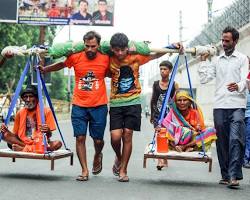
The Kanwar Yatra is one of the most important pilgrimages dedicated to Lord Shiva. Every year, millions of devotees, known as Kanwariyas, travel to sacred places to collect holy Ganga Jal and offer it to Lord Shiva. A major part of this spiritual journey is the Kanwar, which devotees carefully carry throughout the Yatra.
Kanwars can differ in their size, design, decoration, and the way they are carried. These variations reflect the devotion, traditions, and personal preferences of different groups of Kanwariyas.
What Is a Kanwar?
A Kanwar is a traditional structure used by devotees to carry containers filled with holy Ganga Jal. It is generally designed to be carried on the shoulders using a bamboo or lightweight frame.
The Ganga Jal collected by the Kanwariya is later offered to Lord Shiva at a Shiva temple or sacred location. Carrying the Kanwar is considered an important part of the spiritual discipline of the Kanwar Yatra.
1. Simple or Traditional Kanwar
The simple Kanwar is one of the most traditional types used by devotees. It usually consists of a lightweight bamboo structure with two containers hanging from either side.
This type of Kanwar is preferred by devotees who want to focus on their spiritual journey without carrying a heavily decorated structure. Its simple design also makes it easier to carry during long walking distances.
2. Decorated Kanwar
Decorated Kanwars are beautifully designed using colorful cloth, ribbons, flowers, paper decorations, and other decorative materials.
Devotees often personalize their Kanwars according to their preferences. Some Kanwars feature images or symbols associated with Lord Shiva, making them visually attractive while maintaining their religious significance.
3. Jhanki Kanwar
Jhanki Kanwars are designed with a more elaborate appearance and may include decorative structures or representations of religious scenes.
These Kanwars can be larger and more detailed than ordinary Kanwars. They are often created to express devotion through artistic designs and religious themes.
4. Dak Kanwar
Dak Kanwar is associated with devotees who follow a fast-paced Kanwar journey and aim to complete the pilgrimage within a specific period.
The Kanwar is generally designed to be practical and easy to handle because the devotees need to maintain a faster pace. The journey requires considerable physical preparation and dedication.
5. Baithak Kanwar
A Baithak Kanwar is a type of Kanwar that is placed down at designated places during rest periods rather than being continuously carried on the shoulders.
Devotees following this tradition take care to maintain the sanctity of the Kanwar and the holy Ganga Jal throughout their journey.
6. Large and Elaborately Designed Kanwar
Some groups of Kanwariyas carry very large and heavily decorated Kanwars. These may include colorful fabrics, lighting, religious symbols, and elaborate decorative elements.
Although impressive in appearance, larger Kanwars require additional planning because devotees need to manage their size and weight while walking through crowded pilgrimage routes.
7. Group Kanwar
Some devotees travel in groups and carry specially designed Kanwars together. Group Kanwars can be larger and more decorative because several people participate in managing and carrying them.
These Kanwars also represent the sense of unity and brotherhood among Kanwariyas during the pilgrimage.
Importance of Kanwar in the Kanwar Yatra
The Kanwar is much more than a structure used to carry Ganga Jal. For devotees, it represents faith, discipline, dedication, and devotion to Lord Shiva.
During the Yatra, Kanwariyas take great care to keep the Kanwar clean and protect the holy water from being contaminated. The process of carrying the Kanwar over long distances becomes an important part of their spiritual experience.
How Do Devotees Choose a Kanwar?
The choice of Kanwar can depend on several factors, including:
- Distance of the pilgrimage
- Number of people carrying it
- Weight and size of the Kanwar
- Personal preference
- Traditional practices
- Decoration and design
- Physical comfort
For a long walking journey, a lightweight and balanced Kanwar can be more practical. Devotees carrying larger decorative Kanwars may need additional support and planning.
Conclusion
The different types of Kanwar used by devotees show the variety of traditions and expressions of devotion found during the Kanwar Yatra. From simple traditional Kanwars to beautifully decorated and large group Kanwars, each style has its own significance.
Regardless of its size or design, the true importance of a Kanwar lies in the faith and devotion with which it is carried. For millions of Kanwariyas, carrying the Kanwar and offering Ganga Jal to Lord Shiva is a deeply spiritual experience.
Har Har Mahadev!